
Dialectical Behavioral Therapy
for Women
How DBT Supports Recovery from Addiction and Mental Health Disorders

If someone you care about is struggling with addiction, borderline personality disorder, depression, or overwhelming emotions, you may have heard a therapist or treatment center mention dialectical behavioral therapy. But what is it, exactly — and why does it matter so much for women in particular?
Dialectical behavior therapy (DBT) is one of the most well-researched, evidence-based therapies available today for people dealing with intense emotional pain, self-destructive behavior, and co-occurring mental health and substance use disorders. For women, whose addiction and mental health experiences are often shaped by trauma, relationship dynamics, and emotional sensitivity, DBT offers a uniquely effective path toward lasting recovery.
This guide covers everything you need to know: what dialectical behavioral therapy is, who created it, how it works, the principles behind it, and what the research says about its effectiveness — especially for women.
What Is Dialectical Behavioral Therapy?
Dialectical behavior therapy (DBT) is an evidence-based form of psychotherapy that blends cognitive-behavioral techniques with Eastern mindfulness practices. At its core, DBT is built on a single powerful idea: that two opposing things can be true at the same time. A person can accept themselves fully as they are and commit to changing behaviors that are hurting them. This balance — the “dialectic” — is where the therapy gets its name.
Why Is It Called Dialectical Behavioral Therapy/DBT?
The term “dialectical” in dialectical behavior therapy refers to the belief that opposite thoughts and ideas can both be true, creating a balance between acceptance and change. At Canopy Pines, our experts work with residents to hold seemingly contradictory truths simultaneously — for example, “I am doing the best I can” and “I need to do better” — rather than getting trapped in all-or-nothing thinking. This philosophical framework makes DBT uniquely suited for people who experience the world through extreme perceptions.

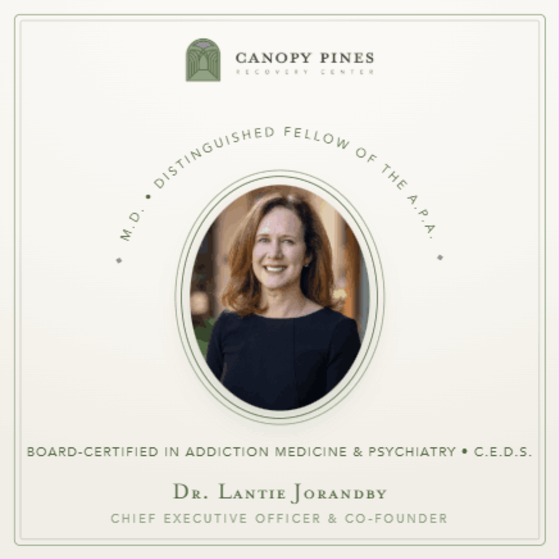
Founded and Led By Dr. Lantie Jorandby
Dr. Lantie Jorandby has dedicated her professional life to treating women with mental illness and addiction, and she is among the most credentialed addiction psychiatrists practicing in the United States today. She is triple board-certified in general psychiatry, addiction psychiatry, and addiction medicine.
What Is Dialectical Behavioral Therapy Used For?
DBT was originally designed to treat borderline personality disorder, but its applications have expanded dramatically. Today, DBT is used to address severe emotional dysregulation, self-harming behaviors, recurrent suicidal thoughts, and a wide range of co-occurring disorders. It is commonly used to treat:
- Substance use disorders (SUD) and addiction
- Borderline personality disorder (BPD)
- Depression and anxiety
- Eating disorders
- Self-harm and suicidal ideation
- Emotional dysregulation in any form
Who Created Dialectical Behavior Therapy?
DBT was developed in 1987 by psychologist Marsha M. Linehan at the University of Washington. Linehan combined cognitive restructuring with acceptance, mindfulness, and behavioral shaping to create an approach unlike anything that existed at the time.
What makes Linehan’s story remarkable is that it is deeply personal. As a young woman, she was in emotional agony and was placed in a secure psychiatric hospital to keep her from harming herself. She emerged from that experience and dedicated her life to creating better treatment for the people who had suffered as she had.
To build DBT, Linehan drew from cognitive behavioral therapy, dialectical philosophy, and Buddhist psychology. Her own spiritual journey — from Roman Catholicism to Zen Buddhism — directly informed the mindfulness practices that sit at the heart of the model. The result was a therapy that is both rigorously scientific and deeply humane.
What Principles Underlie Dialectical Behavioral Therapy At Canopy Pines
DBT at Canopy Pines is grounded in four foundational skill modules, each addressing a different dimension of emotional and relational health. These modules provide specific skills and strategies to help individuals manage their emotions, cope with stress, and improve their relationships.
1. Mindfulness
Mindfulness is generally the first skill residents learn in DBT and is foundational to the entire program. It is the practice of bringing conscious presence and awareness to everyday life — allowing people to observe their thoughts, feelings, memories, and sensations without immediately reacting to or fighting them. For women in recovery, mindfulness helps break the automatic chain between emotional pain and self-destructive behavior.
2. Distress Tolerance
Distress tolerance skills help you get through overwhelming moments when you feel like you’re at your limit — rather than shutting down, lashing out, or escaping through unhealthy behaviors, these skills help you ride out the wave safely. This module is especially critical in early addiction treatment, when cravings and emotional pain are at their most intense.
3. Emotion Regulation
The emotion regulation module helps individuals understand and manage intense emotions. It provides skills for identifying and labeling emotions, increasing positive emotions, and reducing negative emotions — helping individuals avoid impulsivity and make better decisions. Many women entering women’s addiction treatment have spent years using substances as their primary emotional regulation tool. DBT replaces that pattern with healthier, sustainable strategies.
4. Interpersonal Effectiveness
Interpersonal effectiveness skills helps express needs, set boundaries, and build healthier communication patterns — all while maintaining self-respect. These skills teach helpful strategies for asking for what one needs, saying no, and coping with interpersonal conflict. For women whose addiction has often damaged or been sustained by unhealthy relationship dynamics, this module can be life-changing.


How Effective Is Dialectical Behavioral Therapy?
The evidence base for DBT is substantial and continues to grow. Here is what the research shows:
DBT and Co-Occurring Addiction
DBT’s efficacy in treating co-occurring substance use disorder and borderline personality disorder is well established. One study found that women with SUD and BPD who received DBT interventions reported greater reductions in drug use throughout treatment and four months post-treatment, as well as lower dropout rates than those who did not receive DBT.
DBT and Methamphetamine Dependence in Women
Research shows that DBT produces promising results in women with methamphetamine addiction, promoting craving control, emotional regulation, and impulse management, with benefits sustained for at least six months.
DBT and Depression in Women with Addiction
DBT includes skills of distress tolerance, emotional regulation, and interpersonal relations, as well as mindfulness, making it an effective treatment for depression in women with substance use disorders. DBT also provides a combination of cognitive-behavioral strategies that facilitate reduction in maladaptive behaviors through effective coping mechanisms.
Broad Mental Health Benefits
Studies have shown that DBT effectively reduces suicidal behaviors, self-harm, and hospitalizations among individuals with borderline personality disorder, and has also proven effective for treating depression, anxiety, and substance use disorders — particularly for individuals who struggle with intense emotions and interpersonal difficulties.
It is important to note that DBT is rarely used in isolation. Effective addiction treatment typically employs a variety of therapeutic interventions, including cognitive behavioral therapy (CBT), motivational interviewing, contingency management, and others, alongside DBT. The strength of DBT lies in how well it integrates with a comprehensive, personalized treatment plan.

Medically Reviewed By Dr. Lantie Jorandby
Triple Board-Certified in Psychiatry, Addiction Psychiatry, & Addiction Medicine
Last Reviewed: June 2026