
Acceptance and Commitment Therapy Sessions
How Does It Work? What Are It’s Benefits For Women?

If a loved one in your life is struggling with depression, anxiety, or addiction, you may have come across the term “acceptance and commitment therapy,” or ACT, while researching treatment options. ACT is one of the most widely studied and evidence-based approaches used in modern behavioral health care, and it plays a central role in the clinical programming at Canopy Pines Recovery, a women-only residential treatment center in Tallahassee, Florida. This guide explains what ACT is, the principles behind it, who it helps, and what to expect from it in a residential setting.

What Is Acceptance and Commitment Therapy?
Acceptance and commitment therapy (ACT) is a form of psychotherapy developed by psychologist Steven C. Hayes in the late 1980s, rooted in behavioral science and what is known as relational frame theory. Rather than trying to eliminate or argue away painful thoughts and feelings, ACT rests on the premise that pain, grief, and anxiety are inevitable parts of being human, and that lasting change comes from learning to hold those experiences differently rather than fighting them.
The central goal of ACT is psychological flexibility — the ability to stay open to difficult internal experiences, remain grounded in the present moment, and still take action in the direction of what matters most to you, even when it’s uncomfortable. In practice, this means learning to notice a craving, a wave of shame, or an anxious thought without needing to obey it or shut it down. Instead, ACT gives the tools that help choose a next action based on your own values.
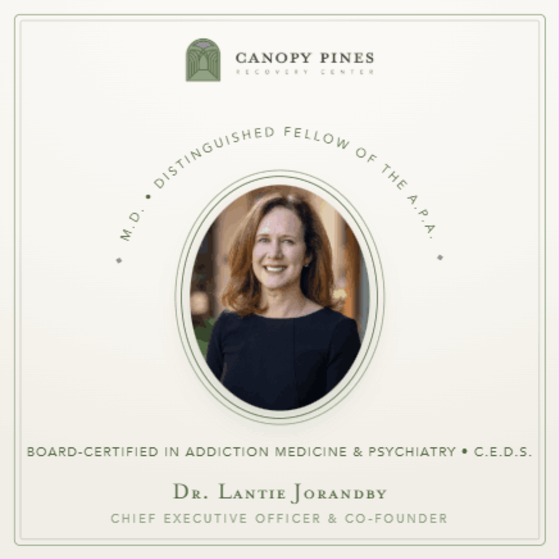
Founded and Led By Dr. Lantie Jorandby
Dr. Lantie Jorandby has dedicated her professional life to treating women with mental illness and addiction, and she is among the most credentialed addiction psychiatrists practicing in the United States today. She is triple board-certified in general psychiatry, addiction psychiatry, and addiction medicine.
How Does Acceptance and Commitment Therapy Work At Our Residential Treatment?
In a residential setting, ACT stops being a once-a-week appointment and becomes part of the daily rhythm of treatment. At a women’s residential program like Canopy Pines Recovery in Tallahassee, ACT is typically delivered through:
- Individual therapy:
- Working one-on-one with a clinician to identify personal values and practice defusion from difficult thoughts.
- Process groups:
- Practicing acceptance and present-moment awareness alongside peers working through similar struggles.
- Experiential exercises:
- Mindfulness practices, values clarification worksheets, and behavioral commitments built into the treatment day.
- Integration with other modalities
- Pairing ACT with trauma-focused therapy, medical detox, and relapse prevention planning.
Because a residential stay provides consistent, structured time away from daily stressors and triggers, clients get many more repetitions of ACT skills — noticing a thought, defusing from it, and choosing a values-aligned action — than they would in a once-weekly outpatient visit. A pilot study of a residential ACT model for substance use and co-occurring conditions found the approach was both feasible and well-received by patients, supporting its use as a structured, transdiagnostic framework inside an inpatient program.
How Is Acceptance and Commitment Therapy Used in Addiction and Mental Health Treatment?
At Canopy Pines Recovery, ACT is typically delivered through a mix of individual therapy, group sessions, and structured exercises, including mindfulness practices, metaphors that illustrate the cost of avoidance, values clarification worksheets, and behavioral commitments you build and revisit between sessions. It is a transdiagnostic therapy, meaning the same core process works across many different conditions rather than requiring a unique course for every diagnosis — which is part of why it fits naturally into dual diagnosis treatment for women facing more than one condition at once.
How Many Sessions Is Acceptance and Commitment Therapy?
There is no single fixed length for ACT, and the right course of treatment depends on the severity of symptoms and whether other conditions are involved. That is why at Canopy Pines Recovery, we tailor all therapy sessions to fit the needs of each individual woman. In a residential program, like at Canopy Pines Recovery, ACT is woven into daily individual and group therapy for the full length of stay, rather than delivered as a stand-alone, time-limited course, so our residents get repeated practice applying the skills in real time.

What Are the Principles of Acceptance and Commitment Therapy?
ACT is built around six interconnected processes that together build psychological flexibility. Understanding these principles helps explain why the therapy works the way it does, both in outpatient settings and in more intensive programs like residential treatment here in Florida.
Acceptance
Making room for difficult thoughts and feelings instead of struggling against them.
Cognitive Defusion
Learning to see a thought as just a thought, rather than fact or command.
Present-Moment Awareness
Staying grounded in what is happening now, not the past or an imagined future.
Self as Context
Building a stable sense of self that can hold difficult experiences without being defined by them.
Values
Clarifying what truly matters to you — as a mother, a professional, a partner, a person in recovery.
Committed Action
Taking concrete, values-aligned steps, even when it’s uncomfortable to do so.
These processes are supported by relational frame theory, a behavioral account of how humans learn to relate words, thoughts, and experiences to one another — and how that process can either trap someone in rigid, avoidant patterns or free them to act on what matters most.
Benefits of Acceptance and Commitment Therapy
ACT was designed to be flexible across conditions, and decades of clinical research now support its use for a wide range of mental health and substance use concerns. Below is how it applies specifically to depression, anxiety, and addiction — three of the most common reasons women seek treatment at Canopy Pines Recovery.
How Does ACT Help Depression?
Depression often keeps people stuck avoiding the very things — relationships, activity, responsibility — that would otherwise support recovery. A controlled trial of a brief, six-session ACT protocol for depression found remission in 60% of ACT participants compared with 22% of a waitlist control group, with roughly 70% of participants classified as recovered or improved by the end of treatment. Rather than trying to argue clients out of negative thoughts, ACT helps them reduce the grip those thoughts have and reconnect with values-driven activity, which research shows is a meaningful predictor of symptom reduction in depression.
How Does ACT Help Anxiety?
Anxiety thrives on avoidance — of situations, sensations, and even certain thoughts. ACT for anxiety specifically targets that avoidance rather than trying to eliminate the anxious feeling itself. Research describes ACT’s approach to anxiety disorders as training both acceptance of unhelpful thoughts and feelings alongside commitment to values-based action, and head-to-head trials comparing ACT with traditional cognitive behavioral therapy (CBT) for anxiety disorders have found the two approaches produce comparable improvements in symptoms, functioning, and quality of life.
How Does ACT Help Addiction?
In addiction treatment, ACT targets the internal avoidance that often drives substance use — using a drink, a drug, or a behavior to numb shame, cravings, or trauma-related pain. A systematic review examining ACT across substance use disorder treatment found that most studies demonstrated a significant reduction in substance use or complete discontinuation with subsequent abstinence. A separate meta-analysis of 32 studies similarly found ACT superior to control conditions for reducing substance use, with moderate to large effect sizes. Rather than treating a craving as something to be eliminated before someone can move forward, ACT teaches clients to notice a craving, let it pass, and act on their values anyway.

Acceptance and Commitment Therapy vs. Cognitive Behavioral Therapy
ACT is sometimes described as part of the “third wave” of cognitive behavioral therapies, and it’s common for clients and families to ask how it differs from traditional CBT. The two approaches share behavioral roots, but they diverge in an important way: CBT generally works to identify and change distorted or unhelpful thoughts, while ACT works to change a person’s relationship to those thoughts rather than the content of the thoughts themselves.
| Acceptance and Commitment Therapy | Cognitive Behavioral Therapy |
|---|---|
| Focuses on accepting thoughts and feelings, not eliminating them | Focuses on identifying and restructuring distorted thoughts |
| Success is measured by values-aligned action | Success is measured by reduced symptom severity |
| Mindfulness and defusion are central techniques | Thought records and cognitive restructuring are central techniques |
| Transdiagnostic — same core process across conditions | Protocols are often tailored to a specific diagnosis |
Neither therapy is universally “better.” A large-scale trial found that CBT and ACT produced large, roughly equivalent improvements in depression, anxiety, and quality of life, though the mechanisms driving change differed between the two groups. Notably, in a randomized trial with incarcerated women in substance use treatment, CBT outperformed ACT immediately after treatment, but ACT proved more effective at long-term follow-up, reducing drug use more than CBT and producing better long-term mental health outcomes. This is part of why Canopy Pines integrates both approaches rather than relying on a single modality, tailoring the mix to each client’s needs through mental health treatment and addiction treatment programming.

How Do Women Especially Benefit From Acceptance and Commitment Therapy?
Women entering treatment for addiction and co-occurring mental health conditions often carry compounded burdens — caregiving responsibilities, trauma histories, and a heightened sense of shame tied to their addiction or diagnosis. ACT’s emphasis on values and self-compassion, rather than on judging or fixing thoughts, tends to resonate strongly with these experiences.
Research specifically involving women bears this out. A randomized trial comparing ACT and CBT for incarcerated women with substance use disorders found that, while CBT had an edge immediately post-treatment, ACT produced significantly better long-term drug use outcomes — 43.8% reduction in drug use for the ACT group versus 26.7% for CBT — along with stronger long-term mental health improvement. A related long-term follow-up study similarly reported durable outcomes for women in drug-dependent populations receiving ACT, and earlier work developing ACT-based interventions specifically for self-stigma found the therapy effective at increasing value-consistent behavior and reducing substance use in people carrying significant shame about their addiction — a pattern especially common among women.
At Canopy Pines Recovery, ACT is delivered inside a women-only community, which allows the values work at the center of the therapy — around motherhood, relationships, career, and identity — to be explored without the added layer of a mixed-gender group setting. Combined with trauma-informed care and medical oversight from our clinical team, ACT becomes one part of a broader, individualized plan for recovery.

Medically Reviewed By Dr. Lantie Jorandby
Triple Board-Certified in Psychiatry, Addiction Psychiatry, & Addiction Medicine
Last Reviewed: June 2026