
Individual Therapy During Residential Rehab
How One-on-One Care Drives Lasting Recovery for Women
Overview
There are things a woman will say to her therapist that she will never say in a group. There are connections she will make — between her childhood and her drinking, between her trauma and her depression, between her relationships and her relapse — that only emerge in the protected space of a private, one-on-one conversation. This is why individual therapy is not simply one component of residential treatment: it is often the place where the most essential work of recovery actually happens.
At Canopy Pines Recovery in Tallahassee, Florida, individual therapy is woven into every phase of our women’s residential treatment program — delivered by licensed clinicians, customized to each woman’s clinical history and goals, and integrated with group therapy, psychiatric care, and trauma-focused treatment.

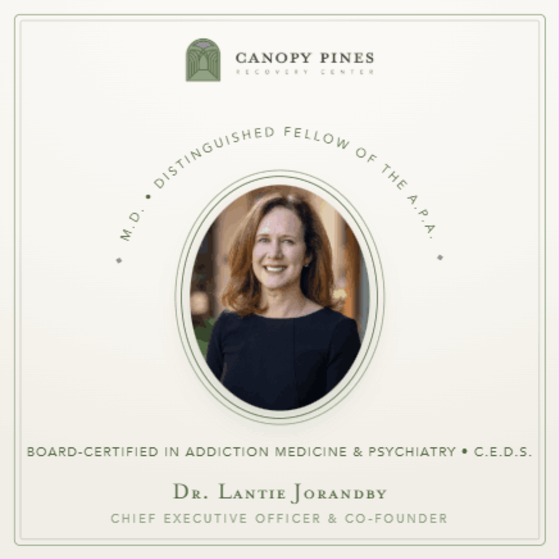
Founded and Led By Dr. Lantie Jorandby
Dr. Lantie Jorandby has dedicated her professional life to treating women with mental illness and addiction, and she is among the most credentialed addiction psychiatrists practicing in the United States today. She is triple board-certified in general psychiatry, addiction psychiatry, and addiction medicine.
What Is Individual Therapy?

Individual therapy — also called individual psychotherapy, one-on-one therapy, or talk therapy — is a structured clinical process in which a person works privately with a licensed mental health professional to address psychological, emotional, or behavioral challenges. According to the National Institute on Drug Abuse (NIDA), individual, group, and family counseling and psychotherapy are the most common treatments for substance use disorders and are delivered by licensed mental health professionals using a range of evidence-based techniques.
What distinguishes individual therapy from other treatment components is its privacy, depth, and personalization. Unlike group therapy, which takes place with peers, individual therapy provides a protected space where a woman and her therapist can focus entirely on her specific history, her specific patterns, and her specific goals — without the dynamics of a group present. The therapist adapts both the approach and the pace to the individual, following the emotional material wherever it leads rather than adhering to a shared group curriculum.
The therapeutic alliance — the quality of trust, collaboration, and working relationship between therapist and client — is consistently identified in research as one of the most powerful predictors of positive treatment outcomes, independent of the specific modality used. Individual therapy is where that alliance is built and sustained.
Benefits of Individual Therapy for Women

Women’s pathways into addiction and mental illness are shaped by experiences — trauma histories, relationship dynamics, caregiving roles, body image, hormonal factors — that are often underserved in generalized treatment models. Individual therapy for women creates a space where those specific dimensions of her experience can be explored fully, at her own pace, without the filtering or self-censorship that can occur in mixed-gender or even all-female group settings.
- Complete confidentiality and personal safety – Individual sessions are protected by therapeutic confidentiality, which allows many women to disclose experiences — abuse histories, sexual trauma, disordered eating, relationship violence — that they are not yet ready to share in any group setting.
- Fully personalized treatment – The therapist tailors every session to the woman’s current state, her history, and her treatment goals. Unlike group formats that follow a set curriculum, individual therapy follows the client — which means the most important material always gets addressed.
- Deeper trauma processing – Research consistently finds that between 55% and 99% of women in addiction treatment have histories of physical or sexual trauma. Individual therapy — particularly trauma-focused modalities like EMDR and trauma-focused CBT — provides a paced, carefully titrated approach to processing that trauma without retraumatizing.
- Uncovering root causes of substance use – Individual therapy helps women identify the underlying thought patterns, unresolved experiences, and emotional coping strategies that drive substance use — reaching the “why” beneath the addiction, not just the surface behavior.
- Building the skills that sustain recovery – Evidence-based modalities used in individual therapy — CBT, DBT, motivational interviewing — teach concrete cognitive and behavioral skills that women carry into daily life long after treatment ends.
- A stable relational anchor throughout treatment – The relationship with an individual therapist provides continuity and consistency across the arc of residential treatment — a constant, trusted point of contact that gives clinical coherence to the broader treatment experience.

How Individual Therapy is Used at Canopy Pines' Residential Treatment
In a residential program, individual therapy does not happen in isolation. It is coordinated with the clinical team, informed by what emerges in group therapy and psychiatric consultations, and aligned with the treatment plan developed at intake. The result is a dynamic, iterative clinical relationship in which individual sessions do the depth work that other components of treatment cannot.

How Does Individual Therapy Work in Residential Addiction Treatment?
In addiction treatment, individual therapy sessions work alongside detox, medication-assisted treatment, and group programming to address the cognitive, emotional, and behavioral dimensions of substance use disorder. According to NIDA, behavioral therapies help patients alter the negative thought processes that lead to substance use, modify their attitudes and behaviors toward drug use, and increase life skills that help them handle stressful circumstances and environmental triggers that might prompt a return to drug use.
In residential individual therapy for addiction, a licensed clinician typically works with each woman on:
- Identifying the thoughts, feelings, and situations that trigger substance use
- Mapping the specific cognitive and emotional pathways that lead to cravings and use for this individual
- Understanding the function substance use has served
- Whether numbing pain, managing anxiety, coping with trauma, or regulating mood — and developing alternative strategies to meet those underlying needs
- Addressing guilt, shame, and self-blame
- Which are among the most powerful drivers of continued use and relapse, and which are best addressed in the privacy of an individual session
- Goal-setting and tracking progress
- Establishing concrete recovery goals, reviewing setbacks without judgment, and adjusting the treatment plan as understanding deepens
- Developing a personalized relapse prevention plan
- Identifying early warning signs specific to this woman’s patterns and building her individualized toolkit for handling high-risk situations
How Does Individual Therapy Work in Residential Mental Health Treatment?

In mental health treatment, individual therapy is often the primary modality through which the core clinical work of recovery takes place. Whether a woman is working through depression, anxiety, PTSD, bipolar disorder, or a dual diagnosis condition, individual sessions provide the dedicated therapeutic relationship and the clinical depth that group-based treatment cannot fully replicate.
In residential mental health individual therapy, sessions typically address:
- Processing traumatic memories and experiences at a carefully managed pace using evidence-based trauma modalities
- Challenging and restructuring the distorted or self-defeating thought patterns that fuel depression, anxiety, or low self-worth
- Building emotion regulation and distress tolerance skills that allow a woman to stay present with difficult feelings rather than avoiding them through substance use or self-destructive behavior
- Exploring the relational patterns — often rooted in early attachment experiences — that contribute to current mental health symptoms and relationship difficulties
- Integrating insight from group therapy, medication management, and experiential therapies into a coherent narrative of healing and recovery
Evidence-Based Modalities Used in Individual Therapy for Addiction and Mental Health
Individual therapy is not a single approach — it is a framework within which clinicians draw on a range of evidence-based modalities matched to each woman’s specific diagnosis, history, and clinical presentation. The most commonly used modalities in women’s residential individual therapy include:
Cognitive Behavioral Therapy (CBT)
One of the most extensively researched psychotherapies in existence, CBT identifies the relationship between thoughts, feelings, and behaviors — and works to disrupt the unhelpful patterns driving depression, anxiety, and substance use. Widely used across virtually all diagnoses.
Dialectical Behavior Therapy (DBT)
Originally developed to treat women with borderline personality disorder, DBT teaches four core skill sets — mindfulness, distress tolerance, emotion regulation, and interpersonal effectiveness — with strong evidence for both BPD and substance use disorder.
EMDR (Eye Movement Desensitization and Reprocessing)
An evidence-based trauma therapy using bilateral stimulation to help the brain reprocess traumatic memories, reducing their emotional charge. EMDR is particularly effective for women with PTSD and trauma-driven addiction. Research finds that up to 59% of young people with PTSD develop substance use problems — making trauma-focused care foundational.
Motivational Interviewing (MI)
A collaborative, goal-oriented conversation style that strengthens a woman’s own motivation and commitment to change, resolves ambivalence about recovery, and builds intrinsic reasons to engage with treatment — particularly valuable in early recovery when motivation may be fragile.
Trauma-Focused CBT (TF-CBT)
An adaptation of standard CBT specifically designed for trauma survivors, integrating psychoeducation about trauma responses, gradual exposure to traumatic memories, and cognitive processing — giving women tools to approach their trauma history without becoming overwhelmed by it.
Psychodynamic Therapy
Explores how unconscious thoughts, early experiences, and relational patterns influence present-day emotional life and behavior. Particularly valuable for women whose addiction or mental health symptoms have deep relational or developmental roots that shorter-term skill-focused approaches may not fully reach.
Benefits of Individual Therapy in a Residential Setting vs. Outpatient Individual Mental Health Therapy
Individual therapy is valuable at every level of care. But the residential setting unlocks dimensions of individual therapy that weekly outpatient sessions simply cannot match — especially for women with complex clinical presentations, trauma histories, or co-occurring disorders.
| Factor | Individual Therapy in Residential Rehab | Individual Therapy Outpatient Only |
|---|---|---|
| Session frequency | Multiple sessions per week — sometimes daily in early treatment | Typically once per week or biweekly |
| Access to substance-free environment | 24/7 structured, substance-free setting removes daily triggers | Patient returns to home environment — with triggers — after each session |
| Clinical team coordination | Therapist coordinates in real time with psychiatrist, nursing, group facilitators, and case manager | Coordination depends on external referrals, often fragmented across providers |
| Trauma processing pacing | Clinical support available around the clock if difficult material surfaces between sessions | Week between sessions may leave a woman managing activated trauma responses without clinical support |
| Crisis response | Immediate clinical response to suicidal ideation, emotional dysregulation, or relapse risk | Crisis contacts available but no on-site support between sessions |
| Treatment completion rates | Research shows treatment completion is more likely to be achieved in residential settings, particularly for women with opioid use disorder or co-occurring conditions | Outpatient dropout rates are significantly higher, particularly in early recovery |
| Integration with full treatment program | Individual therapy directly informs and is informed by group therapy, experiential modalities, and psychiatric care happening the same day | Therapy sessions exist independently, without access to concurrent programming |
What Conditions Benefit Most From Individual Therapy in a Residential Setting?
Many women can benefit from outpatient individual mental health therapy. But certain clinical presentations — by virtue of their severity, complexity, or the level of clinical support required to safely engage in therapy — are best treated in a residential setting where individual therapy is delivered with the intensity, frequency, and clinical integration that recovery demands.
For women managing more than one of these conditions simultaneously — which describes the majority of women entering residential treatment — the need for intensive, coordinated individual therapy alongside other clinical services is particularly acute. In these presentations, the compounding of multiple diagnoses means that the depth of individual work required goes well beyond what one outpatient session per week can support.
A thorough clinical assessment is the starting point for determining the appropriate level of care and the specific individual therapy modalities that will be most effective for each woman’s clinical profile. Some notable conditions that could benefit from residential treatment include:
- Post-Traumatic Stress Disorder (PTSD)
- Major Depressive Disorder with suicidal ideation
- Opioid Use Disorder with co-occurring mental illness
- Alcohol Use Disorder (moderate to severe)
- Bipolar Disorder with substance use
- Borderline Personality Disorder (BPD)
- Complex trauma and adverse childhood experiences (ACEs)
- Eating Disorders co-occurring with addiction
- Treatment-resistant depression or anxiety
- Stimulant use disorder with co-occurring mood disorder
- Dual diagnosis / co-occurring disorders
- Women who have not sustained progress in outpatient-only treatment
Why women specifically benefit from individual therapy in residential settings: Research on individual CBT for women with depression, anxiety, and trauma-related disorders — including a systematic review covering more than 2,500 participants — found that high levels of therapeutic alliance and treatment engagement were strong predictors of positive outcomes. The residential setting uniquely supports both of these factors, by providing frequent, consistent access to the same therapist within a contained, distraction-free therapeutic environment. Source: https://www.ncbi.nlm.nih.gov/books/NBK608012/

Medically Reviewed By Dr. Lantie Jorandby
Triple Board-Certified in Psychiatry, Addiction Psychiatry, & Addiction Medicine
Last Reviewed: June 2026