- The best rehab for you depends on three things: the substance and severity of the addiction, life obligations, and what your insurance or finances allow.
- Alcohol and benzodiazepine dependence usually need medically supervised detox before anything else.
- If depression, anxiety, PTSD, bipolar disorder or another mental health condition is involved, choose a program that treats both together (dual diagnosis care).
- Verify the facility’s Florida DCF license and the clinicians’ Florida licenses before committing.
- Women often do better in programs built around women’s needs, including trauma-informed care.
When someone you love is struggling with drugs or alcohol, searching for help can be difficult. In Tallahassee and across the Big Bend, options can include hospitals, outpatient counselors, detox units, residential programs and online services, and they are not the same level of care. It important to know how choose a rehab that fits a your situation, not just the closest address or the first ad you see.
What Is Addiction Rehab?

Addiction rehab is a proven structured, clinical treatment for substance use disorder. Good programs combine medical care, evidence-based therapy, and planning for life after treatment. Treatment is organized into different levels of care, from around-the-clock medical supervision to a few hours of counseling a week. Most providers use the ASAM Criteria, a national framework from the American Society of Addiction Medicine, to match each person to the right level based on withdrawal risk, medical and psychiatric conditions, relapse risk and home environment.
Levels of Care in Addiction Rehab
-
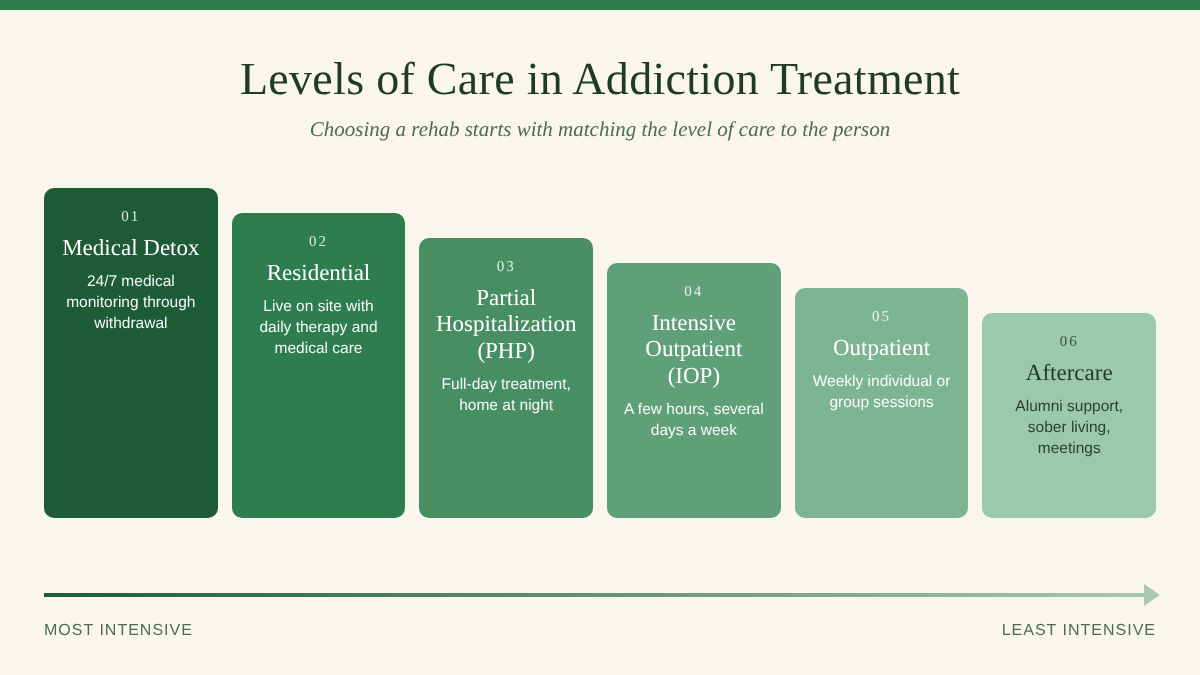
- Medical detox (withdrawal management): 24/7 medical monitoring and medication to get safely through withdrawal. Usually several days to about a week.
- Residential treatment (can also be called inpatient treatment): The person lives at the facility and receives daily therapy, medical care and psychiatric support away from triggers at home.
- Partial hospitalization program (PHP): Full-day treatment, typically five days a week, while living at home or in sober housing.
- Intensive outpatient program (IOP): Several hours of therapy a few days a week, in person or virtual, designed to fit around work or family.
- Outpatient: Regular individual or group sessions, usually once or twice a week.
- Aftercare: Ongoing support after formal treatment, such as alumni groups, sober living, recovery meetings and continued therapy.
Many people move through several levels. A common path is detox, then residential treatment, then PHP or IOP as they return to daily life.
How To Choose A Rehab: It Depends On The Addiction, The Life Situation And The Finances
The National Institute on Drug Abuse states that no single treatment is appropriate for everyone. The right choice comes from considering three aspects:
- The addiction: which substances, how much, how long, and what happened during past attempts to quit.
- The life situation: work, children, legal issues, safety at home, and whether the people around her support recovery.
- The financial situation: insurance coverage, in-network options and what can be paid out of pocket.
A clinical assessment by a licensed professional is the most reliable way to sort this out. Most facilities, like Canopy Pines Recovery, can give free advice on which direction to go, based on the criteria above.
What Level Of Care To Look For Based On The Addiction Criteria
Some Addictions Require Detox
Withdrawal from alcohol and benzodiazepines (such as Xanax, Klonopin or Ativan) can be medically dangerous. Severe alcohol withdrawal may quickly become life-threatening, and the FDA warns that stopping benzodiazepines abruptly can cause seizures, which can be life-threatening. Opioid withdrawal is usually not life-threatening but is very hard to get through alone, and overdose risk is highest right after detox because tolerance drops. If any of these substances are involved, ask whether the program provides on-site medical detox or refers out.

Some Addictions Require Longer-Term Treatment
Detox alone rarely leads to lasting recovery. NIDA’s research-based principles note that medically assisted detox is only the first stage of treatment and that most people need at least three months in treatment to significantly reduce or stop their use. That time can be spread across the different levels of care, such as residential care followed by PHP and IOP. Long histories of use, repeated relapses and polysubstance use usually call for a longer continuum of care.
Some Addictions Require More Intensive Monitoring
Fentanyl and other opioids, heavy daily drinking, and combining substances (especially opioids with benzodiazepines or alcohol) carry higher overdose and medical risk. So do pregnancy, liver disease, seizure history and other serious health conditions. In these situations, look for 24-hour nursing, on-site physicians, and medication-assisted treatment when it is appropriate.

Some People Need Flexible Treatment
Not everyone needs or can step away for residential or inpatient care. Someone with a mild to moderate substance use disorder, a stable and sober home, and responsibilities that cannot be abandoned may do well in an IOP, including virtual IOP. Flexible programs work best when the person is medically stable and not at high risk of relapse at home.
Choosing A Rehab Facility Based On Your Life Responsibilities
Programs That Are More Intensive and Provide a Higher Level of Treatment
Medical detox, residential addiction treatment and PHP offer the most structure and the most hours of care each week. They are usually the right fit when:
- Outpatient treatment has been tried and has not worked
- The home environment includes active use, conflict or abuse
- Withdrawal or medical risks are significant
- A co-occurring mental health condition is severe or unstable
Programs That Are More Intensive and Provide a Higher Level of Treatment
IOP and standard outpatient counseling ask for fewer hours and allow the person to keep working, attending school or caring for children. The trade-off is less supervision, fewer therapies and more exposure to everyday triggers. These programs are often the right next step after residential treatment, and the right starting point for milder cases.
Why Insurance And Finances Can Be The Most Important Factor
For most families, coverage decides which programs are realistic. Under federal parity law, insurance limits on substance use and mental health treatment cannot be more restrictive than limits on most medical and surgical care. That does not mean every plan covers every program. Before choosing, ask:
- Is the program in-network with the plan, and if not, what are the out-of-network benefits?
- Which levels of care are covered, and is prior authorization required?
- How many days does the plan cover, and who handles reauthorization?
- What will the deductible, copays and coinsurance add up to?
Most residential programs, like the ones at Canopy Pines Recovery, will verify insurance benefits for free before admission. For people without insurance, the SAMHSA National Helpline (1-800-662-4357) can point to state-funded and sliding-scale options.
Why Mental Health and Co-Occurring Conditions Matter When Choosing a Program
According to NIDA, about half of people who experience a mental illness will also experience a substance use disorder at some point, and the reverse is also true. When both are present, treating only the addiction often leaves the person with a high chance of relapsing. Programs that offer dual diagnosis treatment address both conditions in one plan with one clinical team.
Signs That Dual Diagnosis Treatment Is Needed
- Substance use started or increased to cope with anxiety, depression, trauma or insomnia
- Mood swings, panic attacks or depression continue during periods of sobriety
- A past or current diagnosis of depression, an anxiety disorder, PTSD, bipolar disorder, borderline personality disorder or an eating disorder
- History of trauma, including abuse or violence
- Previous treatment focused only on addiction, followed by relapse
Research the Facility's Therapies and Credentials
If a co-occurring condition is part of the picture, ask what specific therapies the program uses and who delivers them. Some therapies have strong research behind them for specific conditions:
- Depression and anxiety: Cognitive behavioral therapy (CBT) and medication management by a psychiatrist.
- Borderline personality disorder: Dialectical behavior therapy (DBT), which NIMH notes was developed specifically for people with borderline personality disorder.
- PTSD and trauma: The VA’s National Center for PTSD identifies Cognitive Processing Therapy, EMDR and Prolonged Exposure as the trauma-focused therapies with the most research support.
- Bipolar disorder: Psychiatric medication management combined with therapy and close monitoring for mood changes.
What Credentials to Look For
Ask who is providing these therapies and what training they have. In Florida, look for:
- Psychiatrists who are board certified, ideally with added certification in addiction psychiatry or addiction medicine
- Licensed therapists such as licensed mental health counselors (LMHC), licensed clinical social workers (LCSW), licensed marriage and family therapists (LMFT) or licensed psychologists
- Certified Addiction Professionals (CAP) credentialed through the Florida Certification Board
- Specialized training for specific therapies, such as intensive DBT training or EMDR training from an approved program
You can check any Florida practitioner’s license on the Florida Department of Health license verification portal, and confirm a treatment program’s state license through the Florida DCF Substance Use Disorder Provider Search. Accreditation from The Joint Commission or CARF and LegitScript certification are additional signs that a program meets outside standards.
Mental Health Conditions That May Need a Higher-Acuity Setting
Some situations need a psychiatric hospital or crisis unit before, or instead of, treatment,. These include active suicidal thoughts with a plan, psychosis (hallucinations or losing touch with reality), severe mania, or being unable to eat, sleep or care for oneself. If someone is in immediate danger, call 911 or the 988 Suicide and Crisis Lifeline. Once the person is stable, a residential program with strong psychiatric care can continue treatment.
The Benefits Of A Program With Experiential Therapy
Talk therapy is the foundation of good addiction treatment, but many people, especially those with trauma, find it hard to put their experiences into words. Experiential therapy uses activity and hands-on experience alongside traditional therapy to help people process emotions, practice new skills and build confidence.
How Experiential Therapy Helps Addiction Treatment
- Gives people a different way to process feelings that are hard to talk about
- Builds coping skills that can be practiced in the moment, not just discussed
- Helps restore a sense of enjoyment and purpose without substances
- Keeps people engaged in treatment, which supports staying for the full program
How Experiential Therapy Helps Addiction Treatment
- Equine-assisted therapy: Working with horses to build trust, communication and emotional awareness.
- Art therapy: Drawing, painting and other creative work guided by a trained therapist.
- Music therapy: Listening, writing or playing music to explore emotions and reduce stress.
- Yoga and mindfulness: Body-based practices that help manage cravings, anxiety and stress.
- Adventure and outdoor therapy: Structured outdoor challenges that build confidence and teamwork.
- Psychodrama and role-play: Acting out difficult situations to practice new responses in a safe setting.
Experiential therapy should be part of a full clinical program, not a replacement for evidence-based therapy and medical care.
Women's Substance Abuse Treatment in Tallahassee, Florida: Why Women Need Special Consideration
Substance abuse treatment for women is different from men’s, and it’s important to account for the differences. Research summarized by NIDA shows that women can develop substance use disorders more quickly after first use for some substances, and that women face unique obstacles to treatment as basic as finding child care.
Why Treatment Is Different for Women
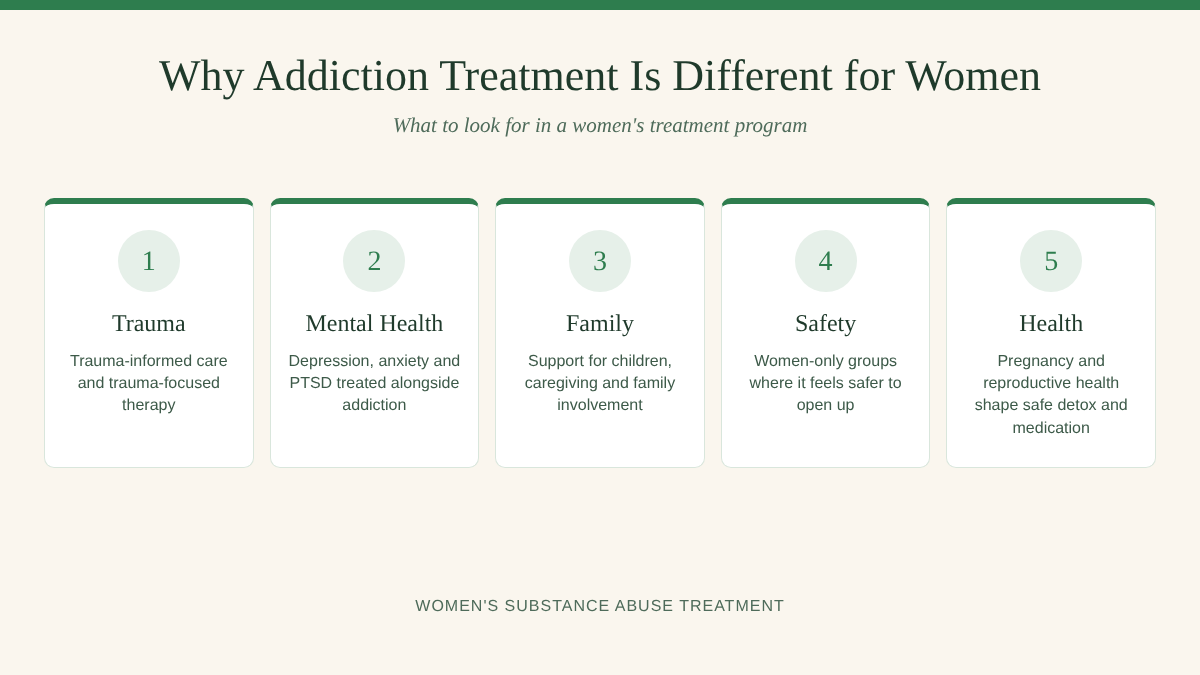
- Trauma: Many women in addiction treatment have experienced trauma, so trauma-informed care matters.
- Co-occurring conditions: Depression, anxiety, PTSD and eating disorders often appear alongside addiction in women.
- Family responsibilities: Concerns about children, custody and caregiving can delay or interrupt treatment.
- Stigma and safety: Women may hide use longer and may feel safer discussing relationships and trauma in a women-only setting.
- Pregnancy and reproductive health: Pregnancy changes which detox and medication approaches are safest.
When comparing programs, ask whether treatment sessions are women-only, if therapists are trained in trauma-focused care, and how the program supports family involvement. Learn more about why treatment is different for women.
Questions to Ask Before Choosing a Rehab in Tallahassee
- Is the program licensed by the Florida DCF, and is it accredited?
- Do you provide medical detox on site, or will she need to go somewhere else first?
- Who leads medical and psychiatric care, and what are their credentials?
- Do you treat co-occurring mental health conditions in the same program?
- Which evidence-based therapies do you use, and who is trained to provide them?
- Do you offer medication-assisted treatment for opioid or alcohol use disorder?
- Is the program women-only or co-ed?
- Are you in-network with our insurance, and what will we owe?
- What is the typical length of stay, and what happens after discharge?
- How is the family involved, and what are the rules for visits and phone calls?
FAQ
Should I choose a rehab close to home or farther away?
Both can work. A program close to Tallahassee makes family involvement easier and simplifies the move to outpatient care afterward. A program farther away can create distance from people and places tied to use. The quality of care and the match to her needs matter more than the distance.
How long does rehab usually last?
Detox usually takes several days to a week. Residential programs commonly run several weeks, followed by PHP, IOP or outpatient care. Length should be based on progress and clinical need, not a fixed number of days.
Can I make a loved one go to rehab in Florida?
Florida’s Marchman Act allows family members and others to petition the court for involuntary assessment and treatment when a person has lost control over substance use and meets specific criteria, such as being likely to harm herself or others. The criteria are set out in Florida Statute 397.675. Speaking with an attorney or the court clerk is the best place to start.
What if I have both an addiction and a mental health condition?
Look for a dual diagnosis program with on-site psychiatric care, so both conditions are treated together by the same team rather than one at a time.